In China's countryside, a Nigerian student found more than a story
来源:China Daily 2026-05-03 15:52
0:00/4:57
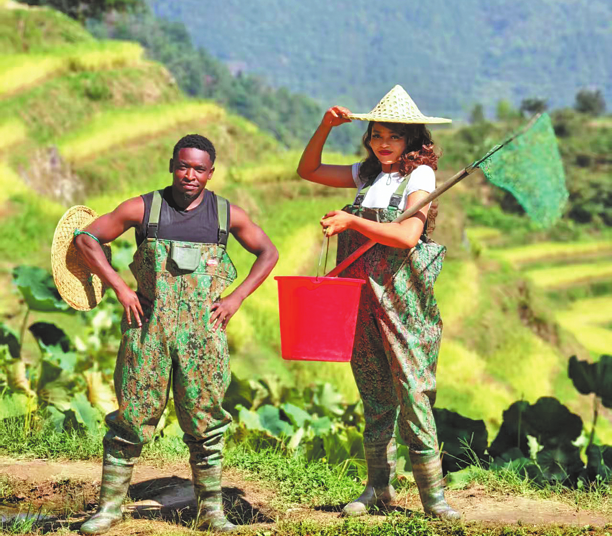
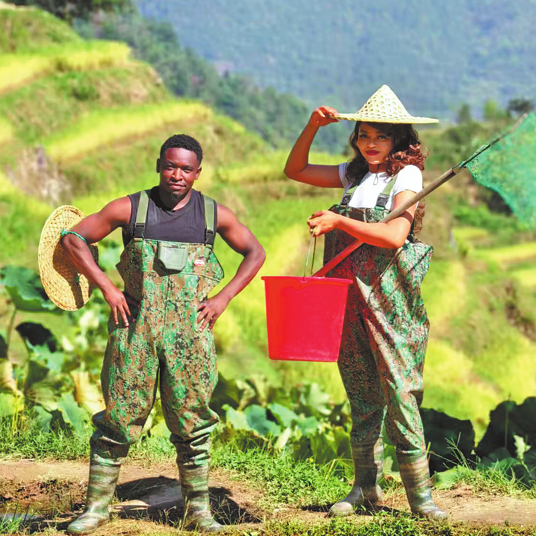
Two international apprentices try their hand at catching fish in a traditional rice-fish co-culture paddy field in Lishui's Yunhe county, Zhejiang province, on Oct 9, 2025. [Photo provided to CHINA DAILY]
Under the blazing summer sun, a young foreign woman in a straw hat steps barefoot into a rice paddy, a fishing net in one hand and a bucket in the other. She wades in the shallow water, feeling around for fish. Before long, her catch is taken to the kitchen and transformed into a steaming Chinese dish.
The woman is Ibeakamma Chinazaekpere Ugochinyere, a Nigerian student better known in China by her Chinese name, Wang Qian.
She is participating in the filming of A Foreign Apprentice Comes to the Mountains, a program in Yunhe county, Lishui, in East China's Zhejiang province, where she is immersing herself in the rhythms, skills and textures of Chinese rural life.
What began as a filming assignment has become something far more personal.
"At first, it was just a project," Ugochinyere said. "But for me, it became much more than a project. It really opened my eyes."
Ugochinyere's interest in China began in primary school. She later won a Confucius Institute scholarship, which turned her childhood aspiration into reality.
"What the Chinese government gave us was not only the opportunity to study, but also a deep affection that crossed mountains and seas," she said. "This land has long become my second home."
She is now pursuing a doctorate at the College of Education at Zhejiang Normal University.
During her 10 years in China, Ugochinyere has evolved from what she describes as a curious explorer of culture into an active participant in China-Africa cultural exchange. Her time in Yunhe, she said, gave that journey fresh meaning.
On camera, she joined villagers in digging up potatoes, making tofu, catching fish and cooking meals. Off camera, she found herself drawn into a way of life that felt both unfamiliar and strangely intimate.
"This experience really made me feel that I was truly enjoying life," she said. "I have always lived in Chinese cities, but when I went to the countryside, I realized that life has another side."
For Ugochinyere, that "other side" lies in the quiet details: mist over the mountains when the curtains are drawn in the morning, a bowl of hot wontons, and a pace of life shaped less by noise and bustle than by land, weather and custom.
"China's rural revitalization is really amazing," she said, a sentiment she returned to more than once.
What impressed her most, however, was not simply that the countryside looked cleaner, newer or more prosperous. It was that in places like Yunhe, and later in Wuyi in Jinhua, development had not come at the expense of memory.
"This project made me understand that while we are advancing modernization, embracing new development, and promoting rural revitalization, we must also preserve old buildings, past history and traditional knowledge," she said.
In her eyes, the old houses, traditional architecture and surviving handicrafts she came across were not relics to be swept aside, but a way for villages to hold on to their identity.
"These old buildings, these old crafts and the things that have been preserved are all telling the story of who they are," she said.
That, for her, is what makes China's rural transformation distinctive. "We welcome development and modernization, but we do not need to lose ourselves, our culture or our history."
The people who left a similarly strong impression on her were the young villagers returning home to build businesses and revive local industries. Ugochinyere met young people helping market farm produce, redesign packaging and promote local goods through livestreaming, bringing new energy to communities where older residents had often lacked the means to reach wider markets.
"I'm really proud of them. They are willing to go back home, bring development, start businesses and promote the products of their villages," she said.
What stayed with her were not grand slogans but small, human moments: elderly villagers greeting the crew with smiles, new dishes appearing each time she returned to Yunhe, and the sense that the changes underway were tangible, lived and shared.
The experience also stirred memories of her own childhood. She recalled growing up amid water, mountains and nature, and said that in some quiet way the Chinese countryside felt familiar.
So when the filming ended, Ugochinyere was not ready to leave it behind.
"If I have time off in the future, I would love to go back, rent a house or stay in a homestay for a while, and spend more time walking around," she said. "I want to work the land again, dig up potatoes again, and experience that feeling once more. I haven't felt that way in many years."
Then, smiling, she reached for a Chinese phrase that had come to sum up what the journey meant to her: "Lucid waters and lush mountains are invaluable assets. China's countryside is truly a treasure."